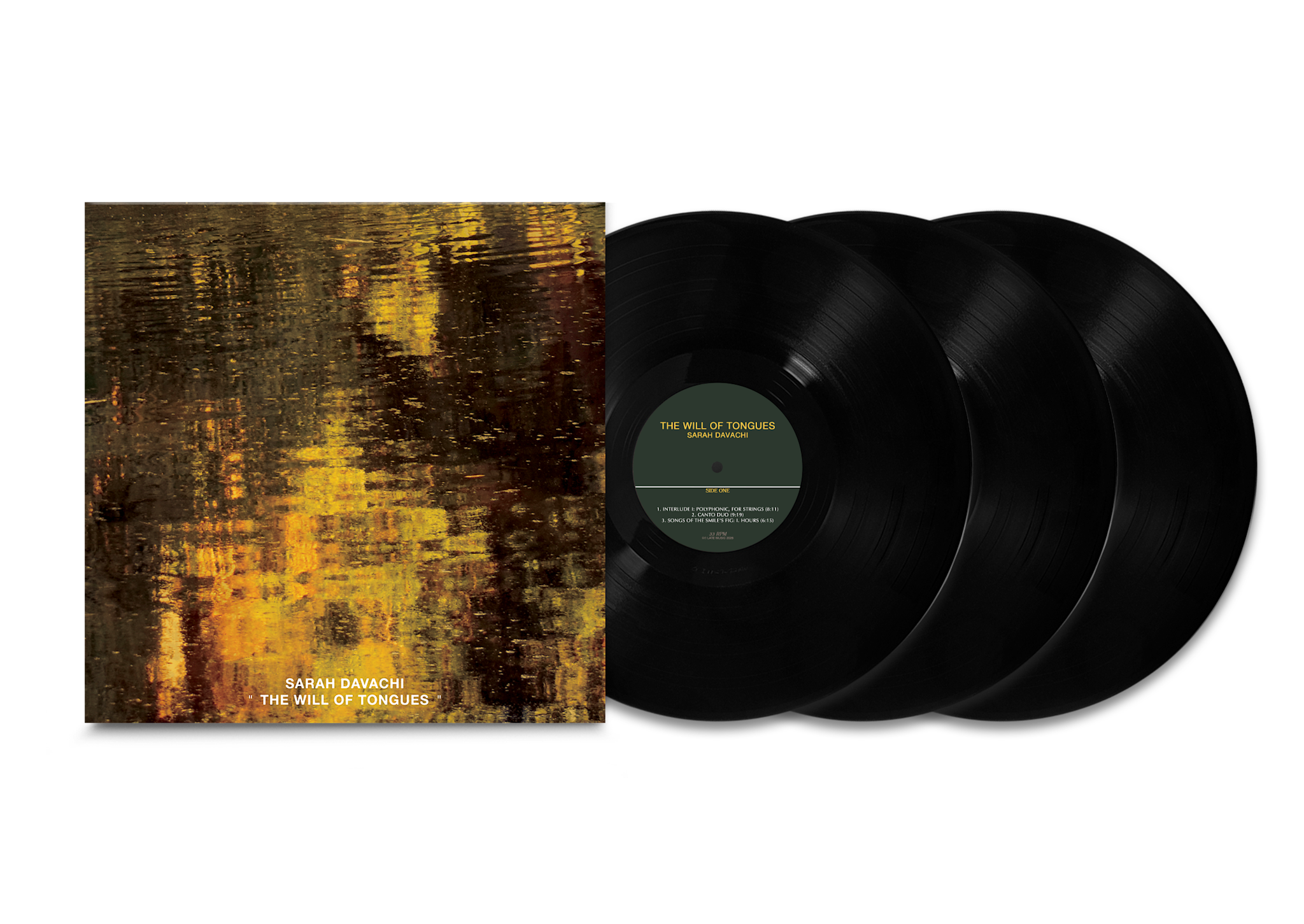
| Format: | 3LP |
| Availability: | In stock |
INCLUDES BONUS POSTCARD DESIGNED BY SARAH DAVACHI
'The Will of Tongues' is the new studio album by Sarah Davachi, and it is certainly her most ambitious to date, spanning over two hours of music across three LPs. The album features five new solo compositions for historical pipe organs (recorded across the USA, Canada, and the Netherlands), a suite of three choral pieces, a collection of “interludes” for various microtonal ensembles (strings, brass, woodwinds), and a longform chamber piece for string trio, organ, and tape. The latter two pieces were commissions from the Experimental Media and Performing Arts Center (EMPAC) in Troy, New York, while the choral work was commissioned by Louth Contemporary Music Society in Dundalk, Ireland.
In addition to Davachi performing on organ throughout, 'The Will of Tongues' also features an incredible group of musicians and ensembles from across the USA and Europe, including Whitney Johnson (viola), Eyvind Kang (viola), Lucy Railton (cello), Diapason (an experimental/microtonal brass ensemble based in Los Angeles, consisting of Nev Wendell, Nicholas Ginsburg, Mattie Barbier, and Mason Moy), Phaedrus (a Renaissance flute consort based in Switzerland, consisting of Liane Sadler, Charlotte Schneider, Mara Winter, and Luis Martinez Pueyo), and Chamber Choir Ireland (conducted by Nils Schweckendiek).
'The Will of Tongues' engages the numerous compositional concepts and methods that have preoccupied Davachi over the past decade especially – including iteration, tuning theory, textural and timbral variation, extended duration, vertical harmony, intervallic affect, and canonic structure, all rooted in the minimalist tradition from which she operates – but with a more pointed and intentional touch than in previous forms. Across its thirteen tracks, ideas hocket from one ensemble or instrument to the next, slowly shifting in balance over the course of what is unmistakably a demanding length.
As a combined body of work, however, the music on this album seeks to articulate a deep reverence for the act of listening, and for the awareness that such listening can serve as a kind of imaginative negative space; one that critically promotes confrontation and creation rather than escape. This collection of music is not easy listening, and it’s not meant to be – when long durations and a reduction of materials are at play, the ear and the mind are forced to truly face the reality of sound itself and the significant mental spaces that it continually gives rise to, which can carry deep wells of meaning if the listener is willing to journey there. 'The Will of Tongues' is thus a celebration of iterative listening and of extreme engagement, of intimate aural experience and its vast psychic horizons.
Nothing expresses us beyond death, and I sometimes cried out: “that is how the will of tongues is made!”