| Format: | LP |
| Availability: | PRE-ORDER |
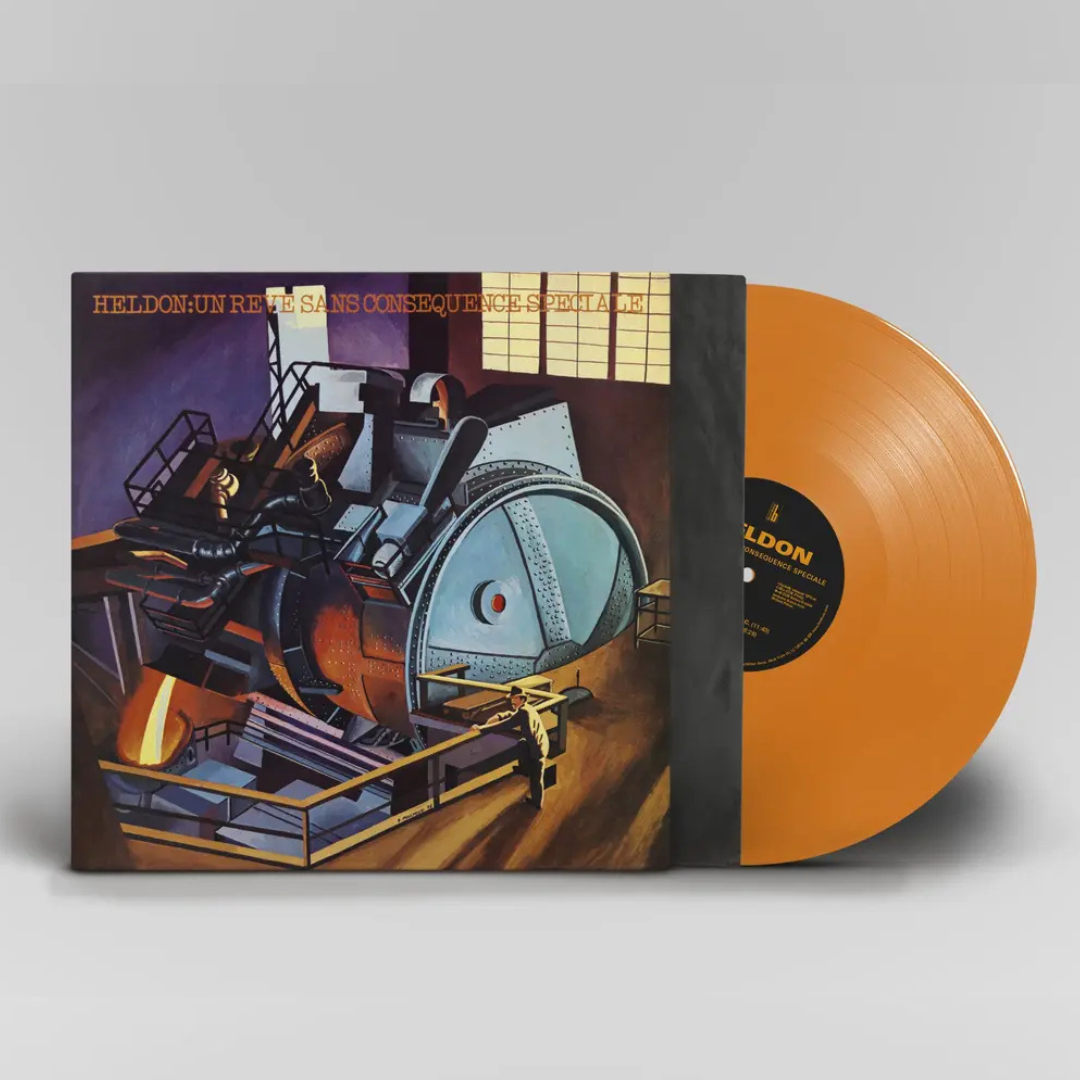
Limited edition on orange vinyl, hand-numbered in 500 copies 50th anniversary edition
With Un Rêve Sans Conséquence Spéciale, also released in 1976, Heldon extend their vocabulary into darker and more concentrated territory. The interplay of synthesizer and guitar is sharpened here, shaped into structures that feel both deliberate and unstable, balancing precision with a latent volatility. The album unfolds with a heightened sense of pressure, its pieces moving between propulsion and fragmentation without settling into fixed form. A compelling document of Heldon at their most focused and intense.
Heldon’s Richard Pinhas has never been shy of pinpointing his influences while, at the same time, making music that is noticeably distinct from any of his designated sources. He has, for instance, made it clear that a significant font of inspiration was Robert Fripp’s guitar style and melding of rock music with cutting-edge electronics (especially in collaboration with Brian Eno). Indeed, Heldon’s fifth album — 1976’s Un Rêve Sans Conséquence Spéciale — was named after a live bootleg of a King Crimson concert.
Pinhas first met Fripp in 1974. The pair became friends, and have remained in contact ever since. Pinhas was even offered a deal with E.G. Records, the company that oversaw King Crimson alongside other successful groups like Roxy Music and ELP. “That was a dream,” says Pinhas. “But when you are 22, you are in a hurry. They asked me to wait one or two years before joining the team. I couldn’t wait two years! At 22, two years is too much.”
Instead, Pinhas forged another path. He launched his own label, Disjuncta, which he later sold to purchase the Moog synthesiser that would make a huge difference to Heldon’s sound. Musical benchmarks aside, Heldon’s output also drew from radical science fiction (Philip K. Dick, Norman Spinrad, etc.) as well as philosophy. The sleeve of the fifth LP features a quote from Pierre Klossowski’s Nietzsche and the Vicious Circle (1969). The book had profound impact on thinkers such as Jean-François Lyotard, who was Pinhas’ PhD supervisor at the Sorbonne, and Gilles Deleuze, another mentor and friend to Pinhas right up until the end of Deleuze’s life.
Pinhas compares his readiness to signpost his influences to citations in academic publications: “In the field of philosophy at university, it’s a normal thing to do.” Besides, Heldon never represented a mere facsimile of Pinhas’ musical touchstones: King Crimson, Jimi Hendrix, Miles Davis, or Frank Zappa. “I don’t want to be them, of course. I don’t feel there is a real relationship between King Crimson’s music and mine. I think Crimson is much better!” Some listeners would beg to differ.