
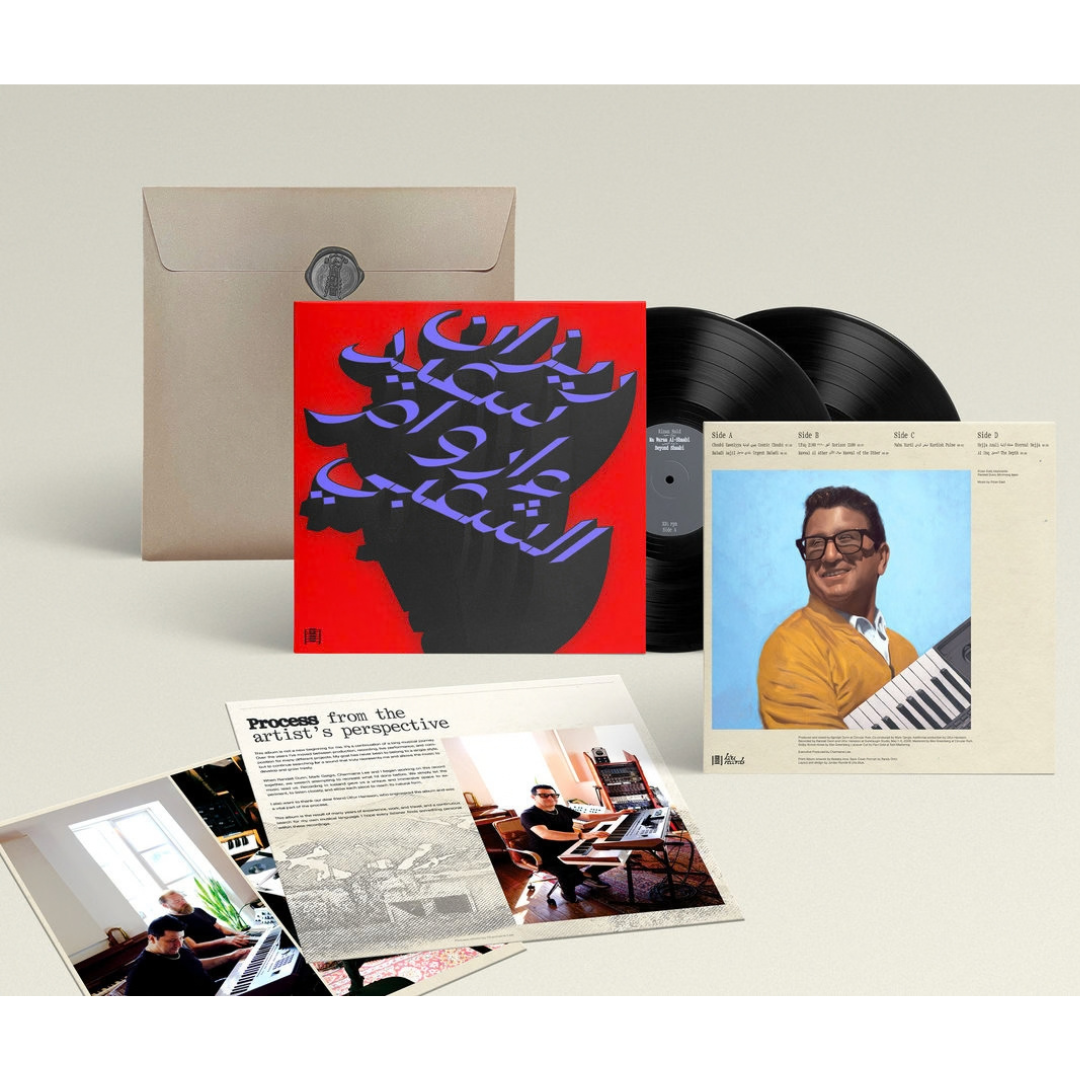
| Format: | 2LP |
| Availability: | PRE-ORDER |
Rizan Said is a musical ambassador from Syria's analog era. For generations, the Jazeera — a culturally rich borderland of Kurdish, Arab, Syriac, and Armenian communities — has been alive with a distinctive sonic tradition: hand drums and reed flutes, weddings that lasted days, dabke rooted in a long musical tradition before electro and disco arrived to name it, and before orientalism arrived to explain it. Rizan was the boy wonder of that scene, a prodigy on percussion and reed instruments who became the region's master synthesist, at the forefront of the shift as electronic keyboards transformed the music.
His instrument is the factory preset, bent past recognition. Across three decades — first on the cassette circuit that ran through Hassake, Deir Ez Zor, and Qamishli, then on stages from Le Guess Who to Iceland Airwaves — Said has programmed Korgs to emulate zurna, saz, tanbura, and buzuq, collapsing an entire traditional ensemble into a single pair of hands moving at lightning speed. It is the sound that carried Omar Souleyman's voice out of the Jazeera and around the world, and for nearly two decades Said was the one building it, night after night, wedding after wedding.
Ma Waraa Al-Shaabi is his third solo album, following King of Keyboard (Annihaya, 2015) and Saz Û Dilan (Akuphone, 2019) and his most far-reaching, carrying cosmic, electronic dabke toward its next destination. Recorded at Sundlaugin in May 2026 and produced by Randall Dunn (Sunn O))), Panos Cosmatos) with co-production by Mark Gergis (Syrian Cassette Archives, Sublime Frequencies) and engineering and additional production by Úlfur Hansson, the record takes the heat and velocity of the cassette circuit and opens it out into something wider, stranger, and more alive than ever. Seven pieces, cut across four sides.
The record is also a reunion. In 2011, Dunn and Gergis worked closely with Said and Souleyman on The Crystalline Series — the three Omar Souleyman versions of Björk's "Crystalline," "Tesla," and "Mawal," made around Biophilia and built on Said's keyboards. Fifteen years later the same circle reconvenes at Sundlaugin, this time with Said at the center of it.
"This album is not a new beginning for me. It's a continuation of a long musical journey," Said says. "When Randall Dunn, Mark Gergis, Charmaine Lee and I began working on this record together, we weren't attempting to recreate what I'd done before. We simply let the music lead us. Recording in Iceland gave us a unique and immersive space to experiment, to listen closely, and allow each piece to reach its natural form."